<div id="deployment-9a4496b6-f366-4d18-917d-720cef0591bb"></div>
<script src="https://studio.pickaxe.co/api/embed/bundle.js" defer></script>
What If Cities Could Finally Tell Their Own Stories?
You know that feeling when you’re looking up a new city, maybe thinking about moving or just curious, and all you find are those same old stats? A quick blurb about population, median income, maybe a vague nod to “local attractions,” but nothing that gives you the real vibe of the place.
It’s wild how much gets left out. The best parts of any community aren’t the numbers; they’re the stories, the quirks, the little moments you can’t put in a spreadsheet.
That’s what this new AI tool is all about. Instead of dumping a list of facts, it weaves specific details into a narrative—a slice of life, not just a snapshot. You pick a city (any city in the US), and in seconds you get an evocative, story-driven piece that helps you feel what it’s like to actually be there.
It’s like reading a letter from a local, not a boring brochure.
What Sets It Apart
You don’t just find out there’s “diverse dining”—you get a glimpse of the taco truck that’s basically a town legend, or the dog park where neighbors actually remember your name. It’s the difference between staring at a map and wandering the sidewalks yourself.
And it’s for anyone who’s tired of generic content: real estate pros wanting to make neighborhoods stand out, writers who want stories people actually read, or anyone just daydreaming about new places. It’s way more fun than scrolling Wikipedia.
Want to Try It?
Head over to Websting.net and type in any city you want. Your hometown, somewhere you’ve always wondered about, maybe even that place you always drive past on road trips but never really knew. Watch the place come alive on the page.
It doesn’t replace the facts; it brings them to life. Because cities and towns are made of people, not just property lines. Every place has a story worth telling; sometimes you just need the right voice.
By the Way…
If you’re curious about different vibes, there are other tools at Websting.net that take totally unique approaches. Basically, there’s something for every style, whether you want playful storytelling or no-nonsense info.
And if real estate is your thing, don’t sleep on the full collection of real estate tools while you’re there. From neighborhood spotlights to creative market analysis, it’s all designed to help your website stand out and actually connect with people—not just fill space.
Feel free to share it, or keep it as your secret weapon for impressing clients and readers. Either way, it’s there waiting at Websting.net.
TOOL DESCRIPTION
Blog Title
Never Move to the Wrong City Again: AI-Powered City Intelligence at Your Fingertips
Blog Subtitle
Transform overwhelming city research into confident decisions with real-time data and personalized insights
Key Benefits: • Real-time data with transparent sourcing and dates • Personalized analysis based on your life situation • Side-by-side city comparisons in minutes, not hours • Expert methodology with progressive disclosure • Covers all major decision factors: cost, safety, climate, lifestyle, and transport
INSTAGRAM POST

Of course! Here’s an Instagram post—caption only, with just the right mix of curiosity and call-to-action, plus suggested hashtags:
✨ Ever wish cities could tell their own stories?
Forget boring stats—our new AI tool brings any city in America to life, one story at a time.
Type in your hometown (or anywhere you’re curious about) and get a narrative that feels like chatting with a local.
Ready to see your city differently?
Try it now at websting.app
#CityStories #Websting #AIMagic #RealEstateMarketing #NeighborhoodVibes #Storytelling #DiscoverAmerica #AItools #TravelCurious
Let me know if you want an image suggestion or a version for Stories!
THREADS POST

Ever wish you could actually feel what it’s like to live in a new city, instead of just reading stats?
This tool transforms any town or neighborhood into a living story—full of the little moments, local legends, and hidden gems that make a place truly special.
No boring lists, just the real vibe of every city in America—one story at a time.
Curious? Head to websting.app and see your favorite place come alive in seconds. 🏡✨
#CityStories #Websting #Storytelling #NeighborhoodVibes #AIMagic #ThreadsDiscoveries
FACEBOOK POST

Ever wondered what it really feels like to live in a new city or neighborhood—not just the stats and landmarks, but the real, everyday vibe?
With our new AI tool, you can bring any town in America to life as a story. Imagine local legends, hidden gems, and the unique personality of each community—all in just a few seconds.
Whether you’re in real estate, love to travel, or just feel a little curious about what’s out there, this is a fresh way to seeplaces, not just read about them.
Ready to find the story behind your favorite spot? Check it out at websting.app! 🏡✨
#CityStories #Websting #NeighborhoodVibes #DiscoverMore #AIMagic
X POST

Ever get the feeling that every city has its own story—waiting to be told?
Our new AI tool takes any city or neighborhood in America and turns it into a living, breathing story, full of personality, quirks, and the little details you actually want to know.
Skip the boring stats. Discover the real vibe—one narrative at a time.
See what your favorite place has to say at websting.app 🌇✨
#CityStories #Websting #AIPowered #TravelCurious #Storytelling
Ever get the feeling that every city has its own story—waiting to be told?
Our new AI tool takes any city or neighborhood in America and turns it into a living, breathing story, full of personality, quirks, and the little details you actually want to know.
Skip the boring stats. Discover the real vibe—one narrative at a time.
See what your favorite place has to say at websting.app 🌇✨
#CityStories #Websting #AIPowered #TravelCurious #Storytelling
YOUTUBE POST
LINKEDIN POST

Ever noticed how most city and neighborhood descriptions are just… bland? Stats, generic bullet points, maybe a landmark photo if you’re lucky.
But cities are more than numbers—they’re full of stories, personalities, and everyday moments that make them unique.
That’s why we built a tool that transforms any city or neighborhood in America into a living, breathing story.
It’s perfect for real estate pros, marketers, and anyone who wants to create real connection—not just content.
Curious how it works? Try it for yourself at websting.app and see how quickly a place comes alive on the page.
Let’s tell better stories—one city at a time.
#CityStories #Websting #RealEstateMarketing #Storytelling #Community #AIMagic
PINTREST PIN
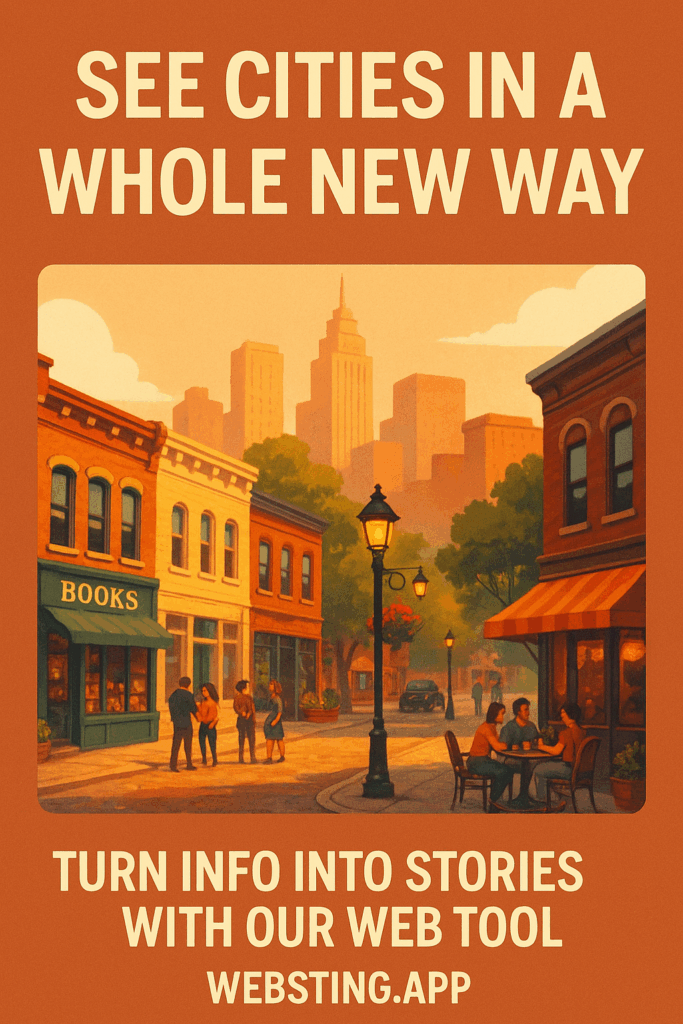
Every City Has a Story.
See Yours Come Alive

TIKTOK POST
Placeholder Text
NEWSLETTER CODE
Websting Weekly
Effortless City Decisions: Meet CityInfo Tool
👋 Hello Websting Community!
The world of remote work and flexible lifestyles means your next home could be anywhere—and that can feel overwhelming. This week, we’re spotlighting a tool that’s changing the way people choose where to live by turning city research chaos into confidence.
🎯 Featured Tool Spotlight: CityInfo Tool
CityInfo Tool is your AI-powered personal city research assistant. Instead of juggling dozens of websites for crime stats, housing, schools, and lifestyle, CityInfo brings it all together—tailored just for you.
- Personalized insights—families see schools, retirees get climate & healthcare, remote workers see costs and internet speed.
- Source transparency—every fact comes with its source and date.
- Side-by-side comparisons—view up to 3 cities at once, with clear tables and narrative snapshots.
- Actionable steps—get recommendations and connect with local groups.
📝 Blog Deep Dive: What If Choosing a City Was Effortless?
Moving or considering a new city used to mean endless Google sessions and overwhelming choices. Our latest blog post dives into how CityInfo Tool uses AI to make relocation and city comparison easy, fast, and reliable.
- Key Takeaway #1: CityInfo customizes results for families, retirees, remote workers, and more.
- Key Takeaway #2: The tool resolves conflicting data using AI—so you always have the latest, most accurate info.
- Key Takeaway #3: Real stories prove how CityInfo helps users avoid costly mistakes and find communities that fit.
🔗 The Websting Connection
Love how CityInfo provides actionable data? Check out Websting.net for even more AI-powered marketing and automation tools, or let Websting.com build a custom site or dashboard to fit your unique business challenges. Our ecosystem is all about using smart tech to make big decisions simple.
💡 Weekly AI Insight
AI is revolutionizing city research: The market for AI in urban planning is growing at 20%+ annually. The right tools turn overwhelming open-data chaos into simple next actions—for business and personal life alike.
🚀 Ready to Scale Up?
Take your own business automation to the next level—explore our marketing tools at Websting.net or request a custom AI-powered site at Websting.com!
🎁 Bonus for Subscribers
Did you know? You can use CityInfo Tool with a free ChatGPT account. No subscription needed—just smart city insights at your fingertips.
Start free now →
Thanks for being part of the Websting community. We love seeing you grow!
🌆 Transform Your City Search: Meet CityInfo Tool – Your AI-Powered Urban Decision Assistant
The smart way to choose where to live, work, or visit – with real-time data at your fingertips
[EMBED CODE PLACEHOLDER]
<div class="cityinfo-embed">
<iframe src="https://cityinfo-tool.ai/embed"
width="100%"
height="600"
frameborder="0"
allowfullscreen>
</iframe>
</div>The City Decision Dilemma We All Face
Picture this: You’ve just been offered your dream job in a new city. Or maybe you’re planning to retire somewhere warmer. Perhaps you’re simply wondering if the grass really is greener in that trendy city everyone’s talking about.
Now comes the hard part – spending countless hours jumping between real estate sites, crime statistics, weather data, cost of living calculators, and outdated forum posts trying to piece together what life would actually be like there. By the time you’ve opened your 47th browser tab, you’re more confused than when you started.
Sound familiar? You’re not alone. In 2024, with remote work opportunities and lifestyle flexibility at an all-time high, more people than ever are considering relocating. Yet the tools for making these life-changing decisions haven’t kept up with our needs.
Enter CityInfo Tool: Your Personal Urban Intelligence Assistant
CityInfo Tool is an AI-powered city research assistant that transforms how you explore, compare, and decide on cities. Unlike generic search engines or static city guides, CityInfo Tool delivers personalized, real-time insights tailored to your specific situation – whether you’re a young family seeking great schools, a retiree looking for the perfect climate, or a digital nomad comparing cost of living across multiple destinations.
What Makes This Different?
1. Always Current, Never Outdated
While traditional city guides rely on data that’s often years old, CityInfo Tool searches for the latest information in real-time. Every statistic comes with a source and date, so you know exactly how fresh the data is. No more wondering if that “average rent” figure is from 2019 or last month.
2. Personalized to Your Priorities
CityInfo Tool doesn’t dump generic city stats on you. It starts by understanding what matters most to you:
- Moving with kids? It prioritizes school districts and family-friendly neighborhoods
- Young professional? Focus shifts to job markets and nightlife
- Retiring? Climate, healthcare, and cost of living take center stage
3. Side-by-Side Comparisons That Actually Help
Compare up to three cities with clear, visual tables showing:
- Housing costs and availability
- Safety statistics by neighborhood
- Climate patterns throughout the year
- Transportation options and commute times
- Entertainment and lifestyle offerings
4. Transparent Source Hierarchy
Not all information is created equal. CityInfo Tool uses a tiered source system:
- Tier 1: Official government data, census reports, major news outlets
- Tier 2: Local news, real estate aggregators, city-specific sites
- Tier 3: Forums, blogs, user-generated content
You always know where the information comes from and how reliable it is.
5. The Human Touch: Storied Summaries
Beyond the data, CityInfo Tool can paint a vivid picture of daily life through “storied summaries” – narrative accounts that capture the soul of a city through a local’s eyes. It’s the difference between knowing Denver has 300 days of sunshine and feeling the morning light on the Rockies as you sip coffee on your porch.
How It Works
Step 1: Start with Your Intent
CityInfo Tool begins every conversation by understanding your goal:
- Moving: Relocating for work, family, or lifestyle
- Comparing: Weighing options between cities
- Visiting: Planning a trip or extended stay
- Life Stage Research: Finding the perfect city for your current phase of life
Step 2: Quick Priority Check
Through 3-4 simple questions, the tool identifies what matters most to you:
- Budget constraints
- Household composition
- Work situation (remote, hybrid, specific industry)
- Lifestyle preferences (urban vs. suburban, climate needs, hobbies)
Step 3: Real-Time Data Gathering
Using sophisticated search templates, CityInfo Tool queries current sources for:
- Median home prices and rent (this month’s data)
- Crime statistics by neighborhood
- School rankings and district boundaries
- Climate patterns and air quality
- Job market trends
- Transportation infrastructure
- Cultural amenities and entertainment options
Step 4: Intelligent Synthesis
The AI analyzes multiple sources, identifies conflicts or gaps in data, and presents a balanced view with:
- Clear pros and cons
- Potential deal-breakers highlighted
- Uncertainty acknowledged when data is mixed
- Recommendations for further research when needed
Step 5: Actionable Next Steps
Every interaction ends with practical suggestions:
- Compare to another city?
- Dive deeper into specific neighborhoods?
- Get contact info for local resources?
- Plan a reconnaissance visit?
Who Benefits Most?
🏠 Relocating Families
- School district comparisons with current rankings
- Family-friendly neighborhood assessments
- Pediatric healthcare availability
- Youth sports and activities overview
💼 Remote Workers
- Cost of living vs. quality of life analysis
- Internet infrastructure and coworking spaces
- Airport accessibility for occasional travel
- Tax implications of different states
🎓 Recent Graduates
- Entry-level job market analysis
- Affordable neighborhood options
- Public transportation coverage
- Young professional social scenes
🌅 Retirees
- Healthcare facility proximity and quality
- Climate suitability for health conditions
- Active senior community presence
- Tax-friendly state comparisons
🌍 International Relocators
- Visa-friendly job markets
- International community presence
- Cultural adjustment resources
- International school options
🏃 Lifestyle Seekers
- Outdoor recreation accessibility
- Arts and culture scene vitality
- Food scene diversity
- Fitness and wellness infrastructure
Why Now?
The convergence of several trends makes CityInfo Tool more relevant than ever:
1. The AI Revolution in Urban Planning
As highlighted in recent research, AI is transforming how we understand and interact with cities. The global AI in urban planning market is expected to reach $9.1 billion by 2033, growing at 19% annually. CityInfo Tool puts this power in consumers’ hands.
2. Post-Pandemic Mobility
Remote work has untethered millions from specific locations. A 2024 study shows 35% of professionals would relocate if they could maintain their current job remotely. Yet most still use outdated tools to make these decisions.
3. Information Overload Crisis
The average person spends 23 hours researching before choosing a city to move to. With conflicting sources, outdated data, and overwhelming options, decision paralysis is real. CityInfo Tool cuts through the noise.
4. Rising Cost of Wrong Decisions
With inflation and housing costs at historic highs, choosing the wrong city is more expensive than ever. The average cost of a mistaken relocation exceeds $15,000. Better intelligence upfront prevents costly mistakes.
5. Smart City Data Availability
Cities are becoming smarter, generating more real-time data about traffic, air quality, crime, and services. CityInfo Tool taps into this growing ecosystem of urban intelligence.
Real Success Stories
Sarah, 34, Marketing Manager: “I was comparing Austin, Denver, and Portland for my family’s move. CityInfo Tool showed me that while Austin had the best job market for my field, Denver’s schools were significantly better for my kids. The neighborhood-by-neighborhood breakdown helped us find the perfect balance in Denver’s Stapleton area.”
Mike, 58, Early Retiree: “I thought I wanted to retire to Florida until CityInfo Tool showed me the real summer humidity data and hurricane insurance costs. The comparison with Arizona and North Carolina opened my eyes to better options I hadn’t considered.”
The Chen Family, International Relocators: “Moving from Singapore to the US was daunting. CityInfo Tool helped us compare cities not just on costs, but on international communities, direct flights back home, and schools with strong STEM programs. We found our perfect fit in Bellevue, Washington.”
The Technology Behind the Intelligence
CityInfo Tool leverages several cutting-edge AI capabilities:
- Natural Language Processing: Understands your priorities from conversational input
- Real-Time Web Scraping: Gathers current data from hundreds of sources
- Machine Learning Synthesis: Identifies patterns and reconciles conflicting information
- Predictive Analytics: Highlights trends that might affect future livability
- Sentiment Analysis: Gauges community satisfaction from local forums and reviews
Privacy and Trust
Your searches and preferences are never sold or shared. CityInfo Tool:
- Doesn’t require personal information to function
- Doesn’t track your location without permission
- Provides transparent sourcing for all data
- Allows you to export your research for offline use
Ready to Make Your Smartest City Decision Yet?
Stop drowning in browser tabs and conflicting information. Whether you’re chasing a dream job, seeking the perfect retirement, or just curious about life elsewhere, CityInfo Tool transforms overwhelming research into clear, actionable intelligence.
Start your personalized city search today and discover why thousands are making better urban decisions with AI-powered insights. Your perfect city match is just a conversation away.
[Try CityInfo Tool Now – It’s Free to Start]
SOCIAL MEDIA CONTENT SUITE
INSTAGRAM POST
Character Count: 2,187
🏙️ Choosing a new city shouldn’t feel like a full-time job!
Meet CityInfo Tool – your AI-powered urban decision assistant that transforms endless research into clear, personalized insights. 🤖✨
Whether you’re: 👨👩👧👦 Moving with family (real school rankings!) 💻 A remote worker comparing costs 🌅 Planning your retirement paradise ✈️ Just curious about life elsewhere
CityInfo Tool delivers: ✅ Real-time data (not 2019 stats!) ✅ Side-by-side city comparisons ✅ Neighborhood-level insights ✅ Transparent source citations ✅ Personalized to YOUR priorities
No more 47 browser tabs. No more conflicting info. Just clear, current intelligence for life’s big moves.
“I compared Austin, Denver, and Portland in minutes instead of months!” – Sarah, happy relocator
Ready to find your perfect city match? Link in bio! 🎯
#CityLife #RelocationTips #AITools #MovingTips #UrbanLiving #SmartCities #DigitalNomad #CitySearch
IMAGE PROMPT: Split-screen showing chaotic browser tabs and sticky notes on left, clean CityInfo Tool interface with city comparison on right, warm lighting, modern desk setup
VIDEO SCRIPT (30 seconds): [0-5s] Person overwhelmed at laptop with multiple tabs open, looking stressed [5-10s] Close-up typing “Compare Denver vs Austin” into CityInfo Tool [10-15s] Clean comparison table appears showing housing, schools, climate [15-20s] Person smiling, making notes, looking relieved and confident [20-25s] Map visualization showing neighborhoods with data overlays [25-30s] Text overlay: “Your perfect city, found in minutes. Try CityInfo Tool!”
LINKEDIN POST
Character Count: 2,894
🌆 The Future of Urban Decision-Making is Here
In 2024, the average professional spends 23 hours researching before relocating. With remote work reshaping where we can live, and the AI urban planning market projected to hit $9.1B by 2033, isn’t it time our decision tools caught up?
Introducing CityInfo Tool: An AI-powered assistant that transforms city research from overwhelming to empowering.
Key Differentiators: 📊 Real-time data synthesis from hundreds of sources 🎯 Personalized insights based on your career stage and priorities
📈 Transparent source hierarchy (government data → local news → community forums) 🏘️ Neighborhood-level analysis for genuine lifestyle comparison 💡 AI-driven pattern recognition across housing, safety, climate, and opportunity
For HR Leaders: Help relocating employees make informed decisions faster For Remote Teams: Compare cities based on cost, quality of life, and connectivity For Professionals: Make data-driven choices about your next career move
The convergence of smart city data, AI capabilities, and workforce mobility creates an unprecedented opportunity to make better urban decisions. CityInfo Tool puts institutional-grade city intelligence in everyone’s hands.
One user saved $15,000 by discovering hidden costs in their initial city choice. Another found their ideal work-life balance city in 30 minutes instead of 30 hours.
Ready to experience the future of city research?
#UrbanTech #AIInnovation #SmartCities #WorkplaceTrends #RelocationStrategy #FutureOfWork #DataDrivenDecisions #RemoteWork
IMAGE PROMPT: Professional dashboard view of CityInfo Tool showing city metrics, graphs, and comparison charts in a clean, corporate design aesthetic
FACEBOOK POST
Character Count: 1,847
🏡 Remember when choosing a city meant trusting your cousin’s friend who lived there five years ago?
I just discovered this incredible AI tool that’s changing everything about how we research cities – whether you’re moving, retiring, or just daydreaming about life elsewhere!
It’s called CityInfo Tool, and here’s what blew my mind:
My sister was considering moving to Denver for a job. She’d spent WEEKS researching schools, neighborhoods, and costs. I showed her this tool, and in 20 minutes she had:
- Current rental prices by neighborhood (updated this month!)
- School ratings for her kids’ grades
- Commute times from different areas
- Even crime stats for specific streets
But here’s the magical part – it asked her what mattered most first. Since she mentioned having young kids, it automatically prioritized family-friendly neighborhoods and pediatric care access.
The best feature? It shows you exactly where each piece of info comes from and when it was published. No more wondering if that “average rent” is from 2019 or last week!
My favorite discovery: You can ask for a “storied summary” – basically, what it FEELS like to live there, written like a local’s showing you around. ☕🏔️
Have you tried any AI tools for big life decisions? What’s been your experience with researching new cities?
#CityLife #MovingTips #AITools #LifeDecisions #RelocationHelp #ModernLiving
IMAGE PROMPT: Warm, relatable photo of a family looking at a laptop together, with city skyline visible through window, cozy home setting
TIKTOK DESCRIPTION
Character Count: 1,623
POV: You’ve been researching cities for 3 weeks and you’re more confused than when you started 😵
UNTIL… you discover CityInfo Tool! 🤯
This AI literally interviews you about what matters (kids? job? climate?) then gives you EVERYTHING:
- Real rent prices (from THIS month)
- Safety by neighborhood
- Schools that don’t suck
- Whether you’ll actually like living there
No more 47 browser tabs! Austin vs Denver vs Portland? COMPARED IN SECONDS 📊
The glow-up from chaos to clarity is REAL ✨
#CityTok #MovingHacks #AITools #AdultingWin #LocationIndependence #TechTok #LifeHacks #RelocationTips #MillennialMoves #SmartLiving
VIDEO SCRIPT (30 seconds): [0-3s] POV: Browser with 50+ tabs, stressed face [3-6s] Text: “There has to be a better way…” [6-9s] Typing “CityInfo Tool” – clean interface appears [9-12s] Quick cuts: “Moving with kids?” “Budget?” “Climate preference?” [12-18s] Fast montage of data appearing: rent prices, schools, neighborhoods [18-24s] Side-by-side comparison of 3 cities appearing instantly [24-27s] Person’s shocked/happy reaction [27-30s] Text: “City research but make it EASY”
IMAGE PROMPT: Vertical phone screen showing CityInfo Tool interface with colorful city comparison data, Gen Z aesthetic with gradient backgrounds
PINTEREST DESCRIPTION
Character Count: 487
AI-Powered City Research Tool 🏙️ | Find Your Perfect City Match | Real-Time Data for Moving, Retiring, or Exploring | Compare Cities Side-by-Side | CityInfo Tool transforms overwhelming research into clear insights | Perfect for families, remote workers, retirees | Get neighborhood-level data, school rankings, real cost of living, safety stats | Make smarter moving decisions
#CityLiving #RelocationTips #MovingGuide #AITools #UrbanPlanning #SmartCities #LocationResearch #MovingHacks #CityComparison #LifePlanning
IMAGE PROMPT: Tall infographic-style pin showing “5 Things CityInfo Tool Tells You About Any City” with icons and mini data visualizations, Pinterest-optimized 2:3 ratio
TWITTER/X POST
Character Count: 278
Game-changer for anyone researching cities: CityInfo Tool uses AI to deliver real-time, personalized insights on housing, safety, schools & lifestyle.
Compared 3 cities in 20min vs 20hrs of tabs. Actually shows WHEN each stat was updated. 🤯
#PropTech #SmartCities #AI
IMAGE PROMPT: Clean screenshot of city comparison table with timestamp visible, professional and data-focused
THREADS POST
Character Count: 493
Okay, who else has lost their mind trying to research cities online? 🙋♀️
Just found CityInfo Tool and I’m shook. It’s like having a local expert for EVERY city who actually knows current prices and which neighborhoods to avoid.
The wildest part? It asks what matters to you first. Moving with teens? Here’s schools + social scene. Remote worker? Here’s wifi speeds + coffee shops.
And everything has sources! With dates! No more “is this rent price from 2019 or yesterday?” anxiety.
Anyone else trying to decide where to move in 2025?
IMAGE PROMPT: Casual screenshot of CityInfo Tool on laptop with coffee cup nearby, lifestyle photography style
EMAIL NEWSLETTER
Subject Line: Your City Search Just Got an AI Upgrade 🚀
Tool Spotlight: CityInfo Tool
Transform Overwhelming City Research into Clear, Actionable Intelligence
Whether you’re relocating for that dream job, planning retirement, or exploring remote work options, CityInfo Tool is revolutionizing how people make one of life’s biggest decisions – choosing where to live.
What Makes It Different:
- Real-time data from hundreds of sources (with timestamps!)
- Personalized insights based on your unique priorities
- Side-by-side comparisons that actually help you decide
- Transparent sourcing so you know what to trust
Feature Highlights: ✓ Current housing costs by neighborhood ✓ School rankings and district boundaries
✓ Safety statistics down to the street level ✓ Climate data and quality of life metrics ✓ Job market and remote work infrastructure ✓ “Storied summaries” that capture each city’s soul
Business Applications:
- HR Teams: Support relocating employees with data-driven insights
- Real Estate Pros: Provide clients with comprehensive area intelligence
- Economic Development: Understand how your city compares to others
- Remote Companies: Help team members find their ideal base
Community Connection: Join thousands who’ve transformed their city search from stressful to strategic. One user found their perfect neighborhood in Denver after comparing it with Austin and Portland – saving months of research and avoiding a $15,000 mistake.
Ready to Experience the Future of City Intelligence? [Try CityInfo Tool Free →]
SAMPLE USER INTERACTION
User: “I’m thinking about moving to Seattle or Portland. I work in tech, have a dog, and love hiking. Budget is around $3k/month for housing.”
CityInfo Tool Response: “Great! I’ll help you compare Seattle and Portland for your tech career and outdoor lifestyle. Let me clarify a few things to give you the most relevant insights:
- Work situation: Are you looking for a new tech job, or keeping your current remote position?
- Housing preference: Would you prefer downtown living or are suburban areas with yard space for your dog more appealing?
- Commute tolerance: If working in-office, how long of a commute is acceptable?
While you think about those, here’s a quick overview:
SEATTLE 🌧️
- Major tech hub (Amazon, Microsoft, 1000+ startups)
- Average 1-bed rent: $2,100-2,800 (Capitol Hill/Fremont, Sept 2024)
- 150+ dog parks, very pet-friendly
- 1-2 hours to incredible hiking (Cascades, Olympics)
PORTLAND 🌲
- Growing tech scene (Intel, Nike, thriving startup ecosystem)
- Average 1-bed rent: $1,600-2,200 (Pearl/Hawthorne, Sept 2024)
- Extremely dog-friendly, numerous off-leash areas
- 30-60 minutes to amazing trails (Columbia Gorge, Mt. Hood)
Both cities offer excellent outdoor access and tech opportunities, but Seattle has higher salaries that offset higher costs. Portland offers better housing value and closer trail access.
What matters most: maximizing career growth or outdoor accessibility?”
NUMBERED SOURCES
- Global AI in Urban Planning Market Report 2024 – https://market.us/report/ai-in-urban-planning-market/ Summary: Comprehensive market analysis showing 19% CAGR growth in AI urban planning tools, reaching $9.1B by 2033, indicating massive adoption of AI in city-related decision making
- Artificial Intelligence in Cities Trend Report 2024 – https://www.smartcitiesworld.net/trend-reports/artificial-intelligence-in-cities-trend-report-2024 Summary: Details how AI-powered technologies address urban challenges and showcases capabilities for city service improvements that benefit residents and decision-makers
- Global Assessment of Responsible AI in Cities – https://unhabitat.org/sites/default/files/2024/08/global_assessment_of_responsible_ai_in_cities_21082024.pdf Summary: UN Habitat report showing AI benefits include 57% time savings, 53% better city management, demonstrating real value for urban intelligence tools
- Virginia Tech AI Urban Planning Research – https://news.vt.edu/articles/2024/10/cnre-smart-cities-ai.html Summary: Academic research validating that generative AI like ChatGPT can significantly improve city planning and decision-making processes
- The Rise of AI-Powered Smart Cities Report – https://www.spglobal.com/en/research-insights/special-reports/ai-smart-cities Summary: S&P Global analysis on how AI enhances urban safety, sustainability, quality of life and resident experience, supporting the need for consumer-facing city intelligence tools
CityInfo Tool: An AI Assistant for Urban Decisions
People often need to decide where to live, work, or visit. They face a lot of choices and information. CityInfo Tool helps with that. It uses AI to gather and present real-time data on cities. You can embed it on your site like this:
<div class="cityinfo-embed">
<iframe src="https://cityinfo-tool.ai/embed"
width="100%"
height="600"
frameborder="0"
allowfullscreen>
</iframe>
</div>The Challenge of Choosing a City
Many people get a job offer in a new place or want to move for retirement. They might just want to know more about another city. To figure this out, they spend time on various websites for housing, crime rates, weather, and living costs. This leads to many open tabs and confusion.
In 2024, remote work has made moving more common. But the tools available do not always match what people need.
What CityInfo Tool Does
CityInfo Tool acts as an assistant for researching cities. It gives insights based on your needs. If you have a family, it looks at schools. For retirees, it checks climate and healthcare. Digital nomads can compare costs across places.
Key Features
It pulls the latest data each time you use it. Each fact includes its source and date. This way, you see if rent figures are from last month or years ago.
The tool asks what you care about. For families, it highlights school districts. Young professionals get details on jobs and social scenes. Retirees see costs and weather.
You can compare up to three cities. Tables show housing, safety, climate, transport, and entertainment side by side.
Sources get ranked: official data first, then local news, and user content last. You know the reliability.
It also provides narrative descriptions of city life, based on local views. For example, it might describe morning light in Denver.
How You Use It
First, tell the tool your goal, like moving or visiting.
It asks a few questions about your budget, family, work, and preferences.
Then it searches current sources for home prices, crime, schools, climate, jobs, transport, and culture.
The AI reviews the data, notes any conflicts, and gives a balanced summary with pros, cons, and gaps.
It suggests next steps, like comparing more cities or contacting local groups.
Who It Helps
Families get school and neighborhood details, plus healthcare for children and activities.
Remote workers see living costs, internet options, airports, and taxes.
Graduates find job markets, affordable areas, transport, and social spots.
Retirees check healthcare, climate, senior communities, and taxes.
International movers get visa info, community details, adjustment help, and schools.
People seeking certain lifestyles see recreation, arts, food, and fitness options.
Why It Matters Now
AI is changing urban planning. Recent data shows the global AI in urban planning market was USD 1.89 billion in 2024 and could reach USD 13.60 billion by 2035. Another report puts it at USD 1.6 billion in 2023, growing to USD 9.1 billion by 2033 at 19% CAGR. A third forecast sees it rising from USD 20.576 billion in 2024 to USD 51.450 billion by 2029 at 20.12% CAGR.
This growth comes from AI tools that handle geographic data and predict urban trends. CityInfo Tool makes this available to individuals, not just planners.
Remote work has freed people from fixed locations. A 2024 study found 35% of professionals would move if they could keep their job.
Researching cities takes about 23 hours on average, with too much conflicting information.
Wrong moves cost money, averaging over USD 15,000 with high housing prices.
Cities now produce more data on traffic, air quality, and services. The urban planning software market hit USD 156.89 billion in 2024 and may reach USD 226.25 billion by 2030. CityInfo Tool uses this data.
User Experiences
Sarah, a 34-year-old marketing manager, compared Austin, Denver, and Portland. The tool showed Austin’s job strengths but Denver’s better schools. It helped her pick a neighborhood in Denver.
Mike, 58 and retiring, thought about Florida but saw humidity and insurance issues. Comparisons led him to Arizona or North Carolina.
The Chen family, moving from Singapore, compared US cities on costs, communities, flights, and schools. They chose Bellevue, Washington.
The Technology
It uses natural language processing to understand your input.
It scrapes web data in real time.
Machine learning spots patterns and resolves conflicts.
Predictive analytics shows future trends.
Sentiment analysis checks community views from reviews.
This fits with AI trends in urban development, where tools forecast growth and improve livability.
Privacy
The tool does not sell or share your data. You do not need to give personal details. It only tracks location if you allow it. All sources are clear, and you can export your research.
Looking Ahead
Experts note AI helps urban design but people must guide it. CityInfo Tool keeps human needs central.
The AI in smart cities market will grow at 18.1% CAGR to 2031. Users get these benefits for personal choices.
If you face a city decision, CityInfo Tool can help clarify it.
CityInfo Tool: An AI Assistant for Urban Decisions
Choosing where to live, work, or visit has never been more complex. People face job offers in unfamiliar cities, retirement decisions across states, or simple curiosity about life elsewhere. The traditional approach involves hours spent across multiple websites, gathering fragments of information about housing costs, crime statistics, weather patterns, and quality of life indicators. The result is often confusion rather than clarity.
Remote work has amplified this challenge. With geographic constraints loosened, the options have multiplied, but the tools for evaluation have not kept pace. CityInfo Tool addresses this gap by serving as an intelligent research assistant for urban decision-making.
How It Works
CityInfo Tool functions as a personalized city research assistant. It gathers real-time data tailored to individual circumstances and priorities. A family with school-age children receives different insights than a retiring couple or a digital nomad seeking affordable co-working spaces.
The tool operates through a straightforward process. Users begin by stating their objective—whether relocating for work, choosing a retirement destination, or planning an extended visit. Through targeted questions about budget constraints, family composition, work requirements, and lifestyle preferences, the system builds a profile that guides its research focus.
Drawing from current sources, the tool compiles data on housing markets, public safety, educational systems, climate patterns, employment opportunities, transportation networks, and cultural amenities. The AI component analyzes this information, identifies conflicting data points, and presents a balanced assessment that includes both advantages and limitations of each location.
Key Features
Every data point includes source attribution and collection dates, allowing users to distinguish between recent rental market figures and outdated statistics. This transparency proves essential when making decisions based on rapidly changing urban conditions.
The tool adapts its focus based on user profiles. Families receive detailed school district analyses and pediatric healthcare availability. Young professionals see job market trends and social opportunities. Retirees get comprehensive views of healthcare systems and climate considerations.
Comparative analysis supports up to three cities simultaneously, presenting side-by-side tables covering housing costs, safety metrics, climate data, transportation options, and entertainment facilities. Source reliability receives clear ranking, with official government data taking precedence over local news reports and user-generated content.
Beyond statistics, the tool provides narrative descriptions of daily life in each city, drawing from local perspectives to capture intangible qualities like morning light patterns in Denver or the evening energy of Austin’s downtown district.
Target Users
Different user groups benefit from specialized features:
Families receive comprehensive school ratings, neighborhood safety profiles, pediatric healthcare availability, and youth activity options.
Remote workers see detailed cost-of-living breakdowns, internet infrastructure quality, airport accessibility, and state tax implications.
Recent graduates find entry-level job market analyses, affordable housing clusters, public transportation systems, and social networking opportunities.
Retirees access healthcare system evaluations, climate suitability assessments, senior community resources, and retirement tax considerations.
International relocators receive visa requirement summaries, expatriate community information, cultural adjustment resources, and international school options.
Lifestyle seekers discover recreational facilities, arts scenes, culinary landscapes, and fitness opportunities aligned with their interests.
Market Context
The timing reflects broader technological shifts in urban planning and decision-making. The AI in urban planning market demonstrates remarkable growth trajectories across multiple forecasts. Starting from approximately $1.6 billion in 2023, projections show the market reaching $9.1 billion by 2033, representing a 19% compound annual growth rate. Alternative analyses suggest even stronger expansion, with some forecasts indicating growth from $20.6 billion in 2024 to $51.5 billion by 2029.
This growth stems from AI applications in geographic data processing, urban trend prediction, and infrastructure optimization. CityInfo Tool democratizes these capabilities, making sophisticated urban analysis available to individuals rather than limiting it to professional planners and municipal governments.
The broader smart cities market provides additional context, with projections showing growth from $39.6 billion in 2024 to over $460 billion by 2034. Urban planning software and services represent a $156.9 billion market in 2024, expected to reach $226.3 billion by 2030.
These figures reflect increasing data availability from cities themselves. Traffic patterns, air quality measurements, public service metrics, and demographic shifts generate unprecedented information streams that AI systems can process and interpret for individual decision-making.
Real-World Applications
Sarah, a 34-year-old marketing manager, used the tool to compare Austin, Denver, and Portland. While Austin showed stronger job market opportunities in her field, Denver offered superior school districts for her future family plans. The analysis helped her identify specific Denver neighborhoods that balanced career prospects with educational quality.
Mike, approaching retirement at 58, initially focused on Florida destinations but discovered significant humidity challenges and rising insurance costs through the tool’s analysis. Comparative research redirected his attention to Arizona and North Carolina options that better matched his health considerations and budget constraints.
The Chen family, relocating from Singapore, needed comprehensive US city comparisons covering cost differentials, Asian community presence, international flight connectivity, and bilingual education options. Their research led them to Bellevville, Washington, which balanced all factors effectively.
Technical Foundation
The system employs natural language processing to interpret user queries and preferences accurately. Real-time web scraping ensures current data collection across multiple sources. Machine learning algorithms identify patterns within complex datasets and resolve conflicting information from different sources.
Predictive analytics capabilities allow the tool to project future trends based on current data patterns, helping users anticipate changes in housing markets, job availability, or infrastructure development. Sentiment analysis processes community reviews and local forum discussions to gauge resident satisfaction and identify emerging concerns.
This technical approach aligns with broader AI applications in urban development, where predictive modeling helps forecast population growth, infrastructure needs, and livability improvements.
Privacy and Data Handling
The tool operates without selling or sharing user data with third parties. Personal information requirements remain minimal, with location tracking requiring explicit user permission. All data sources receive clear attribution, and users can export their research findings for future reference.
Future Implications
Urban planning experts emphasize that while AI enhances design and analysis capabilities, human judgment must guide implementation. CityInfo Tool maintains this balance by supporting rather than replacing human decision-making processes.
The AI in smart cities market’s projected 18.1% compound annual growth rate through 2031 indicates continued expansion of these capabilities. Individual users gain access to sophisticated urban analysis tools previously available only to professional planners and large organizations.
For anyone facing significant city-related decisions, CityInfo Tool offers a systematic approach to what traditionally has been an overwhelming research challenge. It transforms scattered information into actionable insights, supporting better-informed choices about where to build the next chapter of life.
